How Should Ugg Boots Fit?
Ugg boots should feel snug when new — not tight, not loose. The sheepskin moulds to your foot in 5-7 days. This guide explains the snug-at-first principle, break-in timeline, and when to size up or down for the perfect fit.
Ugg boots should fit snug when brand new. Not painfully tight. Not comfortably loose. Snug — the way a firm handshake feels compared to a limp one.
This surprises most first-time buyers. You pull the boots on, feel the sheepskin pressing against your feet from every angle, and think: these are too small. They're not. That snugness is exactly what you want — because genuine sheepskin moulds to your feet over the first 5-7 days of wear, and a boot that feels "just right" on day one will feel too big by week two.
Here's everything you need to know about how ugg boots should fit, when to size up or down, and what the break-in process actually looks like.
The Snug-at-First Principle: Why New Ugg Boots Feel Tight
Genuine sheepskin ugg boots use twin-faced sheepskin — a single piece of hide with dense wool on the inside and suede on the outside. When the boot is new, the wool fibres are at full loft (roughly 15 mm thick in quality boots like Whooga). That's a lot of material pressing against your foot.
Over the first week of wear, two things happen simultaneously:
- The wool compresses. Your body heat and the natural pressure of walking push the dense fibres down where your foot contacts them most — ball of foot, heel, top of toes. The lining loses roughly 3-5 mm of thickness in these areas, creating a custom impression of your foot.
- The suede stretches. The exterior hide has natural give. It stretches 2-4 mm across the widest part of the boot, widening the foot chamber to match your specific shape.
The result: a boot that started snug now fits like it was built around a cast of your foot. This is the entire point of sheepskin footwear. If you skip the snug phase by buying a size up, the boot will eventually feel sloppy — your heel will lift, your foot will slide forward, and you'll lose the cradled feeling that makes ugg boots comfortable.
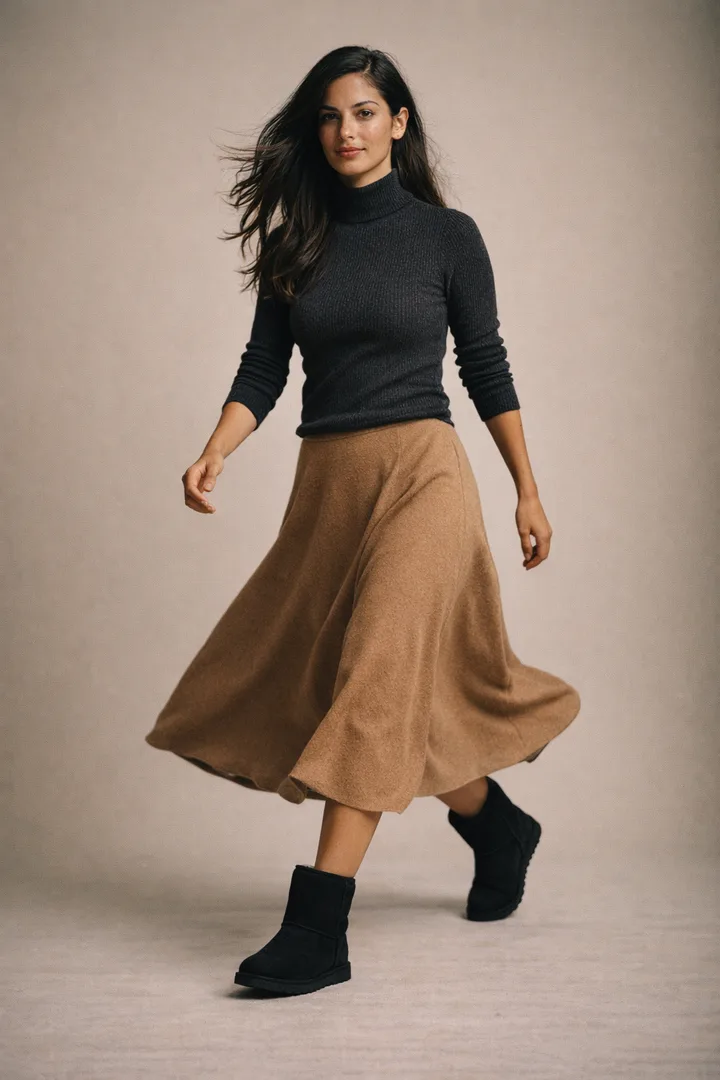
What "Snug" Actually Feels Like (vs. Too Tight vs. Too Loose)
Here's a practical checklist for when you first try on a new pair of ugg boots:
Snug (correct fit):
- The sheepskin lining presses firmly against the top and sides of your toes, but you can still wiggle them slightly
- Your heel sits firmly in the heel cup — no lifting when you walk
- The boot feels like it's holding your foot, not squeezing it
- You can walk around the house without pain, even though it feels tight
- There's no gap between your foot and the lining anywhere
Too tight (size up):
- Your toes are compressed against each other or curled under
- The sides of the boot dig into the widest part of your foot
- You feel pressure on the top of your foot (instep pain)
- Walking is uncomfortable or painful within the first 10 minutes
- You can't get the boot on without a serious struggle
Too loose (size down):
- Your heel lifts out of the heel cup when you walk
- You can fit a finger between your heel and the back of the boot
- Your foot slides forward when you walk downhill or on stairs
- The boot feels comfortable immediately — no snugness at all
- There's visible space around your toes
The Ugg Boot Break-In Timeline
Every pair of genuine sheepskin ugg boots goes through the same break-in stages. Here's what to expect:
Days 1-2: The Snug Phase
The boot feels noticeably tight. The wool is at full height and the suede hasn't stretched yet. Wear them around the house for 1-2 hours at a time. Don't force a full day of wear — your feet need time to make their impression in the sheepskin.
Days 3-5: The Softening Phase
The wool starts compressing under your pressure points. The suede begins to give. The boot noticeably loosens across the forefoot. Most people describe this as going from "tight" to "firm but comfortable."
Days 5-7: The Custom-Fit Phase
The boot has moulded to your foot's specific contours. The lining shows visible impressions where your toes, ball, and heel sit. The snugness is gone, replaced by a cradled, supportive fit that feels personalised.
Weeks 2-4: The Final Settle
Minor additional stretching and compression. The boot reaches its final shape and stays there for the life of the product. Proper sheepskin boots like Whooga's maintain this moulded fit for 4-5 seasons.
For a deeper look at the stretch process, read our guide: Do Uggs Stretch?
When to Size Up in Ugg Boots
The snug-at-first rule has exceptions. Size up half a size if:
- You have wide feet. The standard width of most ugg boots accommodates average-width feet. If your feet are wider than a standard B width, half a size up gives the sheepskin room to stretch around your forefoot without pain. See our detailed guide: Best Ugg Boots for Wide Feet.
- You plan to wear thick socks. Ugg boots are designed to be worn barefoot or with thin socks — the sheepskin lining acts as your sock. If you prefer thick wool socks, you need the extra room.
- You wear orthotics or custom insoles. These take up internal volume. Half a size up (sometimes a full size) compensates for the added thickness.
- You're between sizes and have high-volume feet. High-volume means thick through the midfoot and instep. If your foot is between sizes and high-volume, go up. The extra length is a better trade-off than instep pressure.
When to Size Down in Ugg Boots
Size down half a size if:
- You're between sizes and have narrow or low-volume feet. Narrow feet lose contact with the sheepskin in a larger size, and the moulding process doesn't work as well. Sizing down keeps the lining pressing against your foot where it needs to.
- You've tried the boot and there's no snugness at all. If a new pair of ugg boots feels comfortable from the first step, the break-in process will make them too loose. Exchange for the next size down.
- You're buying for a growing teenager. Tempting to size up "for growth" — but an oversized ugg boot is an uncomfortable ugg boot. Buy the snug size now and replace next season.

How Fit Varies by Boot Style
Not all ugg boot silhouettes fit the same way, even in the same size. Here's what to expect:
Classic Mini and Classic Short: The most forgiving fit. Unstructured upper, flexible sole, wide toe box. These are the easiest boots to get the snug-at-first fit right.
Classic Tall: Same foot chamber as the Short, but the tall shaft can feel restrictive around the calf during the first few wears. The shaft relaxes and slouches with time.
Platform styles: The rigid platform sole doesn't flex or stretch. The upper is also cut slightly narrower. These run approximately half a size smaller in feel than Classic styles. Consider sizing up if you're on the fence.
Lace-up styles: The laces give you adjustability. Start with your normal size and use the lacing to dial in the fit across the instep.
The Insole Test: The Fastest Way to Check Fit
If you're unsure whether a boot fits correctly, do this:
- Pull out the removable sheepskin insole (most quality ugg boots have one).
- Place it on the floor and stand on it with your full weight.
- Look at how your foot sits on the insole.
If your foot sits within the insole edges with 3-5 mm of space all around: Perfect fit. The snugness you feel is just the wool lining — it will compress.
If your foot hangs over the insole edges anywhere: The boot is too small. Size up.
If there's more than 10 mm of space at the toe or sides: The boot is too large. Size down.
This test takes 30 seconds and is more reliable than walking around the house trying to "feel" the fit. For complete sizing charts and AU/US/UK conversions, visit our size guide.
Common Fit Mistakes (and How to Avoid Them)
- Buying for immediate comfort. If the boot feels perfect on day one, it will be too loose by day 10. Accept the snug phase.
- Sizing up for thick socks. Only do this if you genuinely plan to wear thick socks every time. If you'll also wear the boots barefoot, the extra space will make them sloppy on sockless days.
- Judging fit by length alone. Ugg boot fit is more about volume (width + height of the foot chamber) than length. Your toes shouldn't touch the front, but the sides and top of the boot should be pressing gently against your foot.
- Breaking in on a long day out. Wear new boots at home first, 1-2 hours at a time, for the first few days. Forcing a full 8-hour day in brand-new sheepskin can cause blisters on the heel and pressure points on the instep.
Why Whooga Boots Fit the Way They Should
Not all sheepskin boots break in the same way. Cheap boots with thin wool or synthetic lining don't mould — they just stay the same shape forever, which means the fit you get on day one is the fit you're stuck with.
Whooga boots use premium Australian twin-faced sheepskin with dense Merino wool fleece (approximately 15 mm thick). That density is what allows the proper snug-to-custom-fit progression. The wool compresses meaningfully under your foot, and the A-grade suede has the natural elasticity to stretch without losing structural integrity.
If you're buying your first pair, the Core Short or Core Mini are the safest starting points — they have the most forgiving fit and the most predictable break-in.
Frequently Asked Questions
Should ugg boots be tight when you first buy them?
Yes — snug, not painful. New ugg boots should press firmly against your feet from all sides. The sheepskin wool compresses and the suede stretches over the first 5-7 days, creating a custom fit. A boot that feels comfortable on day one will feel too loose after break-in.
How long does it take to break in ugg boots?
Most genuine sheepskin ugg boots reach their final fit within 5-7 days of regular wear. The first 1-2 days feel the snuggest. By day 3-5, the wool has compressed under your pressure points and the suede has begun to stretch. Full moulding completes within 2-4 weeks.
Do ugg boots stretch a full size?
No. Genuine sheepskin stretches approximately 2-4 mm across the forefoot width and loses 3-5 mm of wool loft through compression. That's roughly equivalent to half a size in overall feel, not a full size. If the boot is painfully tight on day one, don't expect stretching to fix the problem — size up instead.
Should I buy ugg boots in my normal shoe size?
For most people, yes. Buy your standard shoe size and expect the snug-at-first fit. Size up half a size if you have wide feet, plan to wear thick socks, or use orthotics. Size down half a size if you have narrow feet and the boot feels immediately comfortable with no snugness.
Can I speed up the ugg boot break-in process?
Wear them around the house with thick socks for 1-2 hours daily during the first week. Your body heat softens the sheepskin and the thick socks apply extra pressure, accelerating the moulding. Avoid using a hairdryer on high heat — it can damage the fibres and cause shrinkage.