How to Clean Ugg Boots
How to clean ugg boots at home, step by step. Remove water stains, salt and odour from sheepskin safely, plus waterproofing and storage tips.
There's a particular kind of intimacy to a pair of sheepskin boots that have shaped themselves to your feet. The wool interior has memorised your arches. The suede has softened at the ankle where you flex. They've become, in a quiet way, yours.
So when a rain puddle leaves a tideline across the toe, or salt from the footpath blooms white up the shaft, the impulse isn't just practical. It's protective. You want to know how to clean ugg boots because something worth wearing is worth looking after.
This guide covers exactly that. Every method here works on any twin-faced sheepskin boot, whether you own Australian sheepskin boots from Whooga or another brand. We'll walk through the full cleaning process, then move into specific fixes for water stains, salt, oil, and mud. Further on, you'll find sections on how to clean ugg boots without a kit, how to clean ugg boots inside, how to clean suede ugg boots safely, and the honest answer to whether you can wash ugg boots in a machine.
Twenty minutes of care. Boots that look and feel like the day you pulled them from the box.
What You Need to Clean Ugg Boots at Home
Gather everything first. A half-wet boot sitting on the bathroom floor while you search for vinegar is a boot developing new water marks.
- Suede brush or soft-bristled brush for lifting dry dirt and restoring the nap after cleaning
- Cold water (never hot, which shrinks sheepskin fibres permanently)
- Sheepskin-safe cleaner such as Nikwax Footwear Cleaning Gel, a dedicated ugg cleaner, or a gentle woolwash solution (enzyme-free, mixed with cold water)
- Two clean, soft cloths for applying cleaner and rinsing
- Newspaper or paper towels for stuffing boots during drying
- White vinegar for salt stain removal
- Cornstarch or white chalk for drawing out oil and grease
- Waterproofing spray (sheepskin-safe, like Nikwax Nubuck & Suede Proof)
If you don't have a dedicated ugg cleaning kit, don't worry. We cover how to clean ugg boots without a kit further down, using household items you likely already own.
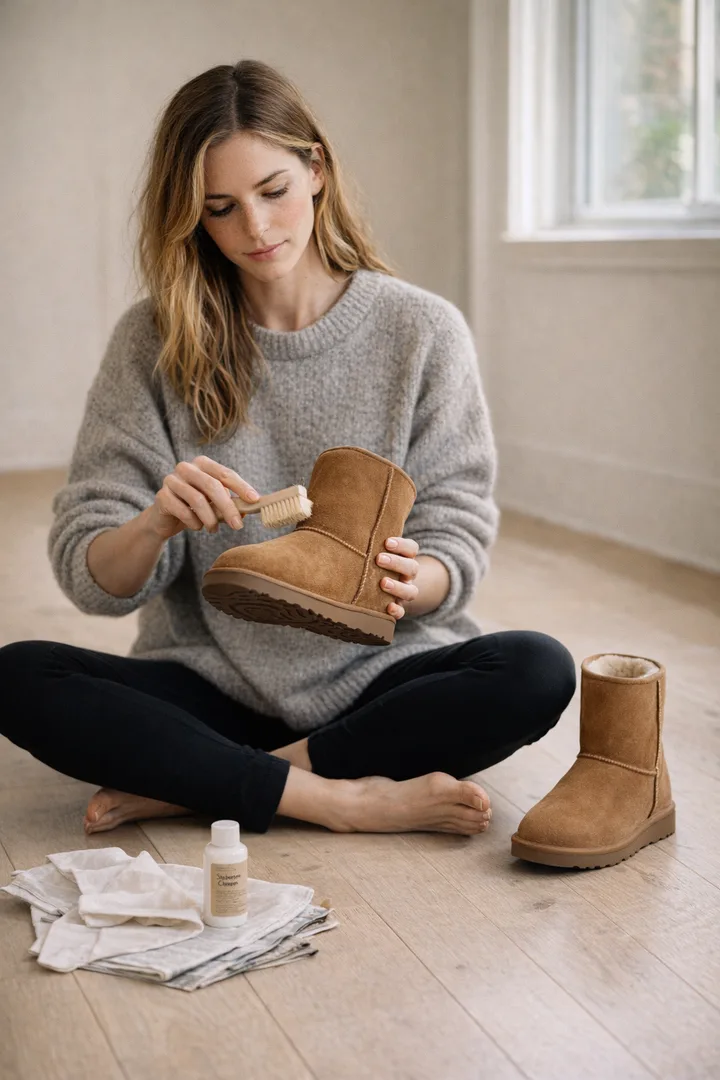
How to Clean Ugg Boots: The Full Step-by-Step Method
This process takes about 20 minutes of active work, then 24 to 48 hours of patient drying. The patience is the hard part. The cleaning itself is surprisingly gentle.
Step 1: Brush Away Dry Dirt
Hold the boot at the ankle. Using your suede brush, sweep the entire outer surface in light, single-direction strokes from top to bottom. The toe box and heel collect the most grime, so give them an extra pass.
This step matters more than it seems. Wetting dirty suede grinds particles deeper into the fibres. You're not cleaning yet. You're clearing the way.
Step 2: Dampen the Entire Boot Evenly
Wet a clean cloth with cold water and wring it until just damp, not dripping. Dab the whole outer surface, working top to bottom. The word to hold onto here is evenly. If you only wet the stained area, you'll create a new water mark where damp meets dry.
Never soak sheepskin boots or hold them under a running tap. You want the suede damp to the touch, not saturated. Too much water penetrates the twin-faced sheepskin and can permanently damage the dense wool interior.
Step 3: Apply Your Ugg Cleaner with a Soft Cloth
Squeeze a small amount of sheepskin cleaner onto your damp cloth (roughly a coin-sized amount per boot). Work it into the suede using gentle circular motions, starting at the shaft top and moving toward the sole. You should see a light lather.
No dedicated cleaner? A tablespoon of enzyme-free woolwash in a bowl of cold water works well. Avoid dish soap, laundry detergent, or anything with harsh surfactants. These strip the natural oils that keep sheepskin supple.
Step 4: Work Stubborn Marks with the Suede Brush
For stains that didn't lift in Step 3, use your suede brush to gently coax the cleaner into the mark. Short, light strokes. Circular motions on set-in spots. Think of it as persuasion, not force.
Step 5: Rinse with a Fresh Damp Cloth
Take your second cloth, dampen it with fresh cold water, and wipe the entire boot to remove every trace of cleaner. Rinse and re-dampen as needed. Soapy residue left on suede dries into a stiff, chalky film that's harder to remove than the original stain.
Step 6: Stuff with Paper to Hold the Shape
Crumple paper towels or clean newspaper and press them firmly into each boot, right down to the toe. This absorbs interior moisture and keeps the boot upright so it dries in its natural silhouette. Replace the stuffing after a few hours if it feels damp.
Step 7: Air Dry for 24 to 48 Hours
Set the boots in a well-ventilated spot away from direct sunlight, radiators, and heaters. Let them dry naturally. The suede will feel slightly stiff as it dries. That's normal.
Never use a hairdryer. Never set them on a heating vent. Never leave them in a hot car. Direct heat warps the sole, shrinks the sheepskin, and can crack the suede in ways that aren't reversible. For a deeper look at safe drying methods, see our guide on how to dry ugg boots.
Step 8: Brush to Restore the Nap
Once fully dry, give the boots a final brush with your suede brush, stroking in one direction. This brings back the soft, velvety texture and removes any lingering stiffness from the cleaning. Your boots should now look noticeably fresher and feel like themselves again.
How to Clean Ugg Boots Without a Kit
Not everyone has a dedicated ugg cleaning kit on hand, and that shouldn't stop you from caring for your boots. You can clean ugg boots without a kit using items already in most kitchens and bathrooms.
Here's what to substitute:
- Instead of a sheepskin cleaner: Mix one tablespoon of enzyme-free woolwash (or a very small amount of mild hand soap) into a bowl of cold water. The key is gentleness. Anything designed to cut grease aggressively will also strip the natural oils from your sheepskin.
- Instead of a suede brush: A clean, dry toothbrush works for small areas. For the full boot, a lint-free cloth with a slight texture (like terrycloth) can lift surface dirt.
- Instead of waterproofing spray: There's no true household substitute for this. But cleaning your boots properly and letting them dry completely gives them the best chance without a protectant. Pick up a sheepskin-safe spray when you can.
The method stays the same: brush dry, dampen evenly, clean gently, rinse thoroughly, stuff, and air dry. The products matter less than the technique. Patience and cold water are the two things that actually protect sheepskin.
If you want the full recommended toolkit, a quality ugg cleaning kit typically includes a suede brush, sheepskin shampoo, and protector spray. Worth the small investment if you plan to keep your boots for years.
How to Get Water Stains Out of Uggs
There's a quiet irony in sheepskin care: water itself leaves marks. A few raindrops dry into visible tidelines that look worse than the puddle that caused them. But the fix is counter-intuitive and satisfying once you understand why it works.
Water stains appear because one area of the suede got wet and dried at a different rate than the surrounding material. The mineral deposits in the water concentrate along the drying edge, leaving a visible line. The solution is to even out the equation.
- Dampen a clean cloth with cold water and wipe the entire boot surface evenly. Not just the stained spot. The whole boot.
- Stuff with paper towels and air dry away from any heat source.
- Brush with a suede brush once completely dry.
The stain vanishes because the whole boot now dries at the same rate. No edge, no tideline. It feels almost too simple, but it works every time.
For stubborn or older water marks, and for other types of discolouration, our guide on how to remove stains from ugg boots goes deeper into targeted treatments.
How to Remove Salt, Oil, and Mud Stains
Salt Stains
Those white blooms that appear after walking on treated winter footpaths aren't just unsightly. Left untreated, salt draws moisture out of sheepskin and causes cracking over time.
- Mix equal parts white vinegar and cold water.
- Dip a clean cloth into the solution and gently dab the salt-stained areas.
- Wipe with a separate cloth dampened with plain cold water to lift the vinegar.
- Stuff and air dry as usual.
- Brush once fully dry.
Treat salt early. The longer it sits on sheepskin, the harder the damage is to reverse.
Oil and Grease Stains
Oil is the trickiest stain because water makes it worse. You need to draw the oil out, not spread it around.
- Sprinkle a generous layer of cornstarch directly onto the stain.
- Pat the powder down gently so it sits in full contact with the mark.
- Leave it overnight (at least 8 hours). The cornstarch absorbs oil slowly as it sits.
- Brush off the powder with your suede brush in the morning.
- Repeat if residue remains.
Don't reach for water and soap first. Water pushes oil deeper into the fibres and spreads the stain outward.
Mud Stains
Mud is one of the easier problems to fix, but only if you resist the urge to act immediately.
- Let the mud dry completely. Walk away. Do something else.
- Once fully dry, use your suede brush to flake the dried mud off with firm, short strokes.
- If a faint shadow remains, follow the general cleaning steps above.
Wet mud, when wiped, smears into the suede grain and sets. Dry mud cracks off cleanly. The best thing you can do is nothing, for a few hours.
How to Clean Suede Ugg Boots
All standard ugg boots have a suede exterior (the outer face of twin-faced sheepskin), so everything in this guide applies to cleaning suede ugg boots. But suede has a few specific sensitivities worth understanding on their own.
Suede is leather with an open, napped surface. That softness you feel when you run your thumb across the boot is the raised fibres of the hide. It's beautiful, and it's also why suede absorbs liquids and shows marks more readily than smooth leather.
Three rules for suede care specifically:
- Always brush in one direction. Back-and-forth brushing tangles the fibres and creates dull, flat patches. Pick a direction (top to bottom works well) and stay consistent.
- Never use coloured cloths when wet-cleaning. Dye can transfer from a damp cloth onto light suede. White or undyed cloths only.
- Test any cleaning product on a hidden area first. The inside of the shaft near the top, or the back heel seam, are good test spots. Wait for the test area to dry fully before cleaning the visible surfaces.
If your suede has developed a generally flat or dull look (rather than a specific stain), a dry brush and a pencil eraser on scuff marks often do more good than a full wet clean. Suede responds well to regular light maintenance between deep cleans.
These same principles apply to your Classic Short ugg boots and every other sheepskin style in the range.
How to Clean Ugg Boots Inside
The outside of a boot faces the world. The inside faces you. And after weeks of barefoot wear, the dense wool interior that makes sheepskin boots so comfortable can start holding onto moisture, body oils, and the kind of lived-in scent that tells you these boots have been loved a little too hard.
Knowing how to clean ugg boots inside extends their life and keeps the wool lining performing the way it should: wicking moisture away from your skin and regulating temperature naturally.
Deodorising the Interior
- Sprinkle 2 to 3 tablespoons of baking soda into each boot. Tilt and shake gently so the powder reaches every part of the lining.
- Leave overnight, at least 8 hours. The baking soda absorbs trapped moisture and neutralises odour at the source.
- Tip the boots upside down and shake out the excess. Use a vacuum with a soft brush attachment to remove residual powder from the wool fibres.
For a subtle antibacterial boost, mix 2 to 3 drops of tea tree oil into the baking soda before sprinkling. Tea tree is a natural antibacterial that leaves a clean, barely-there scent.
Repeat this once a month during heavy-wear seasons. For persistent odour issues, our guide on how to stop ugg boots smelling covers deeper interventions.
Cleaning the Wool Lining
If the interior needs more than deodorising (visible discolouration or matted wool), you can lightly clean it:
- Mix a small amount of enzyme-free woolwash into cold water.
- Dip a clean cloth into the solution and wring it nearly dry.
- Gently wipe the interior wool lining, working in small sections.
- Follow with a cloth dampened in plain cold water to remove soap.
- Stuff with paper towels and air dry completely (48 hours minimum for the interior).
Don't saturate the inside. The wool lining sits directly against the suede exterior, and excessive moisture can cause the layers to separate or warp. Light and careful wins here.

Can You Wash Ugg Boots in the Washing Machine?
No. And this is one of those answers that doesn't come with caveats or workarounds.
A washing machine's drum agitation is violent compared to what sheepskin can tolerate. The cycle tears at the bond between the suede exterior and the wool interior. The sole warps. The sheepskin fibres break down and lose their structure. Boots that go into a machine come out misshapen, stiff, and often with the lining separating from the shell.
A tumble dryer compounds the damage. Heat shrinks sheepskin dramatically and unevenly. What was once a boot becomes something you wouldn't recognise.
Can you wash uggs in the machine on a gentle cycle? Still no. Even the gentlest cycle involves more mechanical force than hand cleaning, and the temperature fluctuations inside a machine are difficult to control. Cold water on a gentle setting is still more disruptive than a damp cloth in your hands.
The hand-cleaning method described above takes 20 minutes. It's the only safe way to wash ugg boots, and it produces better results than any machine cycle ever could. Your hands are gentler, more precise, and they can feel when the suede has had enough water. A machine can't.
How to Clean Ugg Slippers
Ugg slippers follow the same care principles as boots, with one difference: slippers tend to absorb more foot moisture because they're worn indoors, often daily, and almost always barefoot.
Clean ugg slippers the same way you'd clean boots (brush, dampen, clean, rinse, dry), but pay extra attention to the interior. The baking soda deodorising method described above is especially useful for slippers, and you may want to do it fortnightly rather than monthly if you wear them every day.
One additional tip: slippers have a lower shaft, which means they dry faster than tall boots. But they're also easier to over-wet because there's less surface area to distribute the moisture across. Use a lighter hand with your damp cloth and be especially careful not to saturate the sole area, where moisture can pool and weaken the bond between layers.
How to Waterproof Ugg Boots
If cleaning is the cure, waterproofing is the prevention. A good protector spray is the single most effective thing you can do to keep stains from forming in the first place.
Before First Wear
Apply a sheepskin-safe waterproofing spray to new boots before they go outside. Hold the can about 15 cm from the surface and spray evenly across the entire boot, including the seams. Let them dry for 24 hours before wearing.
Our full guide on how to waterproof your ugg boots covers product recommendations and technique in detail.
Ongoing Protection
Reapply every 2 to 3 months during regular wear, or after every deep clean. The protective layer wears off gradually. When water stops beading on the surface and starts soaking in, it's time.
Recommended: Nikwax Nubuck & Suede Proof or Scotchgard Suede & Nubuck Protector. Avoid silicone-based sprays. They clog the pores of natural sheepskin and reduce the breathability that makes these boots comfortable in the first place.
What Not to Do When Cleaning Sheepskin Boots
Sheepskin is durable when treated with respect. But it's also surprisingly easy to damage with the wrong approach. A few things to avoid:
- Machine washing. The agitation destroys fibres, warps soles, and separates the wool lining from the suede.
- Tumble drying. Heat shrinks sheepskin fast and unevenly.
- Hairdryers, heaters, and radiators. Direct heat cracks and stiffens suede permanently.
- Bleach or harsh chemicals. These strip natural colour and the oils that keep sheepskin soft.
- Hot water. It shrinks sheepskin fibres. Cold water only, always.
- Aggressive scrubbing. Hard pressure damages the suede nap and can leave bald, shiny patches that don't recover.
If your boots feel slightly snug after cleaning, don't panic. Sheepskin can shift a little when damp. Wear them around the house for a day and the wool will reshape to your foot. For more on how sheepskin behaves over time, see our guide on whether uggs stretch.
How to Store Ugg Boots Between Seasons
The way you store boots during the off-season matters as much as how you clean them. Damp, creased, or poorly ventilated storage creates mould, odour, and permanent shape loss.
- Clean first. Always give your boots a full clean and let them dry completely before storing. Putting away dirty boots locks in stains and bacteria.
- Stuff them. Fill each boot with acid-free tissue paper to hold the shaft's natural shape.
- Store upright in a cool, dry, well-ventilated spot. Avoid plastic bags or sealed containers. Sheepskin needs airflow. A cotton dust bag or the original box with the lid cracked open works well.
- Keep them out of direct sunlight. UV fades suede colour steadily over time.
- Drop a silica gel packet inside each boot to absorb ambient moisture.
When you pull them out next season, brush lightly and reapply waterproofing spray before the first wear. For the full method, see our guide on how to store ugg boots properly. And if you're wondering about fit after months in storage, our ugg size guide can help.
A Care Routine That Lasts Years
Cleaning sheepskin boots isn't complicated. It asks for the right products (or reasonable substitutes), cold water, gentle hands, and the willingness to let them dry on their own time. The mistakes that ruin boots are almost always about impatience: hot water to speed things up, a machine to save effort, a heater to skip the wait.
The wool interior of a well-cared-for pair of sheepskin boots gets softer with every wear. The suede develops a patina that's yours alone. These aren't boots designed to look brand new forever. They're designed to age well, with you, if you let them.
To understand just how long a pair can last with proper care, see our guide on how long ugg boots last.
Frequently Asked Questions About Cleaning Ugg Boots
Can you wash uggs in the washing machine?
No. Never put sheepskin boots in a washing machine or tumble dryer. The agitation destroys sheepskin fibres, warps the sole, and often separates the wool lining from the suede exterior. Hand cleaning with cold water and a sheepskin-safe cleaner is the only safe method.
How often should I clean my ugg boots?
A full clean every 3 to 4 months during regular wear is a good rhythm. Brush off surface dirt after every few wears to prevent buildup, and spot-treat stains the moment you notice them. The sooner you address a mark, the easier it lifts.
How do I get water stains out of uggs?
Dampen the entire boot evenly with a cloth and cold water (not just the stained area), then stuff with paper and air dry. The stain disappears because the whole surface dries at the same rate, removing the tideline effect. For stubborn marks, repeat the process or follow with a light clean.
Can I use vinegar to clean ugg boots?
A solution of equal parts white vinegar and cold water works well for salt stains specifically. Dab it onto the affected area, then wipe with plain cold water. Don't use vinegar as a general cleaner. For whole-boot cleaning, stick to a sheepskin-safe product or a gentle woolwash.
How do I clean the inside of my ugg boots?
Sprinkle 2 to 3 tablespoons of baking soda into each boot and leave overnight to absorb moisture and odour. For deeper interior cleaning, wipe the wool lining with a cloth barely dampened in diluted woolwash, rinse with a plain damp cloth, and air dry for at least 48 hours.
How to clean ugg boots without a cleaning kit?
Use a tablespoon of enzyme-free woolwash mixed into cold water as your cleaner, a clean toothbrush or textured cloth as your brush, and follow the same steps: brush dry, dampen evenly, clean gently, rinse, stuff, and air dry. The technique matters more than the specific products.
Do ugg boots shrink after cleaning?
Only if you use hot water or direct heat to dry them. Stick to cold water and natural air drying, and your boots should return to their original shape. If they feel slightly snug after a clean, wear them around the house for a day. Sheepskin moulds back to your foot quickly.
How do I stop my ugg boots from smelling?
Baking soda left inside overnight absorbs odour effectively. For extra antibacterial action, mix a few drops of tea tree oil into the powder before sprinkling. Repeat monthly during heavy wear. Letting your boots air out between wears (rather than storing them in a closed cupboard) also helps significantly.