Why Are Ugg Boots Expensive
Why are ugg boots so expensive? We break down sheepskin costs, manufacturing, and what goes into a quality pair — plus what to look for when choosing your next boots.
Why are ugg boots so expensive? The short answer: sheepskin is genuinely costly to produce. The longer answer involves everything from sheep breeds and tanning chemistry to sole construction and stitching technique — details most of us never think about when we're standing in a store, turning over a boot, and reading the tag.
This guide walks through where money actually goes when sheepskin becomes footwear. We'll cover raw materials, manufacturing, and the business costs layered on top — so you can judge for yourself whether any given pair is worth what's being asked.
What Actually Drives the Cost of Ugg Boots
Even if a company ran on zero profit, sheepskin boots would still cost real money. The material demands it.
Twin-Face Sheepskin: One Hide, Two Surfaces
The defining feature of a genuine ugg boot is twin-face sheepskin. That means the wool lining and the suede exterior are the same piece of hide. Not glued layers. Not a wool insert stitched inside a leather shell. One continuous material, with wool on one side and suede on the other.
This matters because it's what creates the thermal regulation that synthetic boots can't replicate. Wool fibres trap air, wick moisture, and breathe. The suede acts as a windbreak. Together, they keep feet warm in winter and surprisingly cool in mild weather. If you're curious about how this works at a material level, our guide on what ugg boots are made of goes deeper.
Getting that hide from a sheep to a boot is where the cost stacks up:
- Sourcing. Not all sheepskin is equal. The breeds raised in Australia and New Zealand produce wool with the right density, fibre length, and softness for footwear. Hides from other regions often lack the thickness or uniformity bootmakers need.
- Grading. Every hide gets inspected for wool density, leather thickness, blemishes, and colour consistency. Only a fraction pass for premium footwear. The rest go to rugs, linings, or lower-grade products.
- Tanning. Raw hides are perishable. Tanning preserves the leather, softens the suede, and stabilises the wool so it won't shed or mat. This is a multi-day chemical process with tight tolerances. Rush it and the leather cracks within a season.
- Dyeing. Achieving consistent colour across a batch of natural hides (each slightly different in tone and texture) requires precision. Chestnut, sand, charcoal: the colours look simple, but getting them uniform across 200 pairs is not.
By the time a finished hide reaches the cutting table, the material cost for a single pair sits between $30 and $60 AUD. That's before anyone picks up scissors.

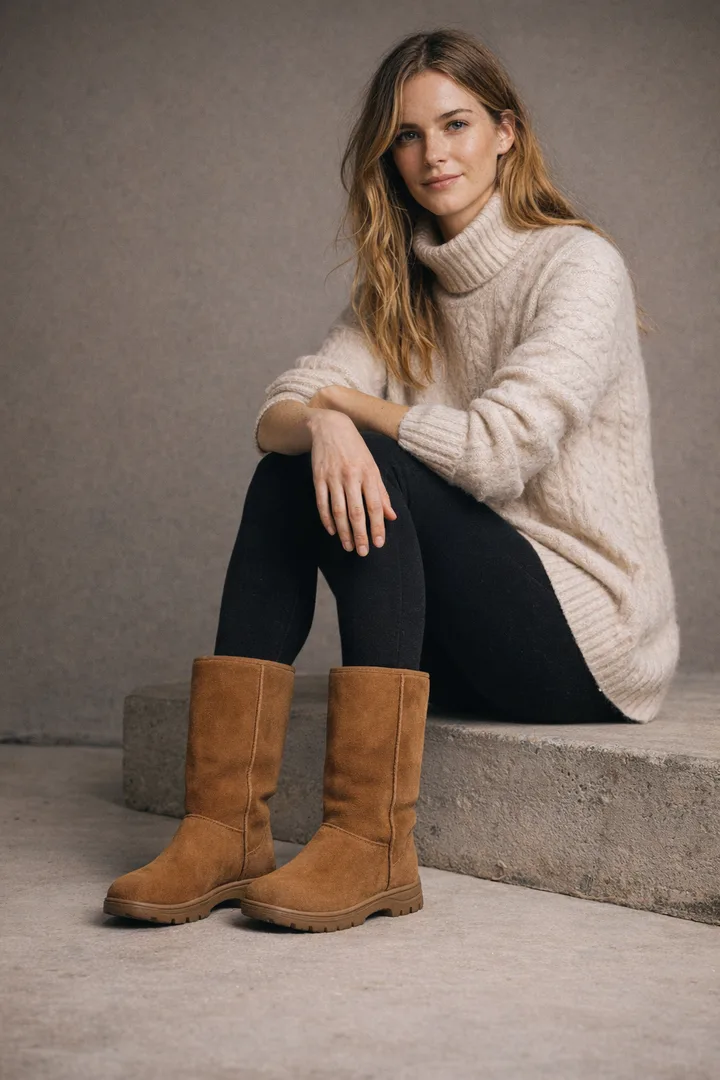
How Much Do Uggs Cost to Manufacture?
Sheepskin doesn't behave like fabric. It's thick, variable, and unforgiving of mistakes. Manufacturing costs reflect that.
Cutting
A skilled cutter lays pattern pieces across each hide to avoid thin spots, scars, and inconsistencies. Because every hide is slightly different (natural material, not a bolt of polyester), this is partly an art. The waste rate is higher than synthetic cutting, and that waste is expensive material going in the bin.
Stitching
Sheepskin requires heavier sewing machines and operators who know the material. The needle has to penetrate suede and wool without tearing either. Seams need double-stitching at stress points (where the shaft meets the foot, around the heel) or they'll pull apart under normal wear. This is the step where the difference between a $60 boot and a $160 boot becomes physical. Poorly stitched seams are the first thing to fail.
Sole Construction
A moulded EVA or rubber sole gets bonded (and sometimes stitched) to the upper. The adhesive and curing process has to withstand winter moisture, pavement flex, and years of walking. Thin, flat soles bonded with weak glue are the hallmark of boots built to a price point rather than a quality standard.
Inspection
Every finished pair gets checked: stitching consistency, sole alignment, wool density, colour match between the left and right boot, structural integrity. This step catches the boots that would generate returns and complaints. It costs time. Skipping it costs reputation.
Add it up and the labour, equipment, and quality control to turn raw sheepskin into a finished pair of boots runs $25-50 AUD, depending on complexity and where the factory sits.
The Gap Between Ugg Boots Cost and Ugg Boots Price
So we've got $55-110 AUD in materials and manufacturing for a well-made pair. Yet ugg boots price tags often sit at $250-400 AUD, sometimes higher. The difference comes down to business model costs that sit on top of production.
- Retail distribution. Boots sold through department stores pass through distributors and retailers, each adding their margin. These are standard costs of doing business at scale.
- Brand building. Endorsement deals, advertising campaigns, and social media presence all cost money and get factored into product pricing.
- Physical retail. Flagship stores in high-traffic locations carry significant rent and staffing overheads.
None of this is unusual — it's how most consumer brands operate. Understanding these layers simply helps you read a price tag with more context.
Are Ugg Boots Worth It?
This is the question people actually want answered, and it depends entirely on what you mean by "it."
If "it" means genuine twin-face sheepskin boots from a reputable maker: yes. Unambiguously. The material performs in ways synthetics don't. Natural warmth without overheating. Moisture wicking that keeps feet dry. A lining that moulds to your foot shape over time instead of flattening out. And durability that stretches across years, not months.
The Cost-Per-Wear Case
A well-made sheepskin boot, properly cared for, lasts 3-5 years of regular wear. If you wear them four days a week through a six-month winter, that's roughly 100 wears per year, 300-500 across the boot's life.
Even at the higher end of the price range, quality sheepskin boots work out to under a dollar per wear. That makes them one of the more sensible footwear investments, especially compared to synthetics that flatten and lose insulation within a season or two.
For the full longevity picture, including care tips that extend boot life, see our guide on how long ugg boots last.
How Whooga Approaches Sheepskin Boots
At Whooga, we work with A-grade Australian twin-face sheepskin and sell direct from our Melbourne workshop. We source locally, manufacture here, and control quality from raw hide to finished boot.
Our model is straightforward: focus on materials and construction, sell direct, keep the range focused. Quiet luxury. Australian made.
Browse our Classic Short boots to see what we mean.


How to Judge Whether a Price Is Justified
Not all expensive boots are overpriced. And some attractively priced boots are terrible. Here's what to look for.
Signs the Boots Deserve the Price
- Twin-face sheepskin confirmed. Pull the lining gently at the shaft opening. It should feel continuous with the suede, not like a separate insert.
- Dense, springy wool. Press the lining with your thumb. The fibres should bounce back immediately. Thin, flat wool means low-grade hide or synthetic fibre.
- Double-stitched stress points. Check where the shaft meets the sole and around the heel. Single stitching here is a shortcut that leads to splitting.
- Proper sole. Adequate thickness, defined tread pattern, clean bonding to the upper. Paper-thin soles with no tread wear through in weeks.
- Consistent finish. Uniform colour across the pair, no visible glue at seams, even suede texture.
Signs the Quality Doesn't Match the Price
- Descriptions say "premium materials" without naming them.
- The wool lining feels uniform in a way that natural fibres don't (a synthetic tell).
- Visible adhesive at seam lines.
- Single stitching at stress points.
- Paper-thin soles with no defined tread pattern.
Our guide on how to spot fake ugg boots covers the material tests in more detail.
What About Boots That Look Like Uggs but Cost Less?
The market for sheepskin-style boots is wider than most people realise. Beyond the big international names, there are Australian makers producing genuine twin-face sheepskin boots at prices that reflect materials and labour rather than brand positioning.
The key is knowing what to look for. If the sheepskin is real, the construction is solid, and the maker stands behind the product, you don't need a famous name on the box. You need a good boot.
We wrote a full comparison of boots like uggs that breaks down how different brands stack up on materials, construction, and pricing. Worth reading if you're weighing your options.
The Philosophy of "Expensive"
We tend to conflate price with quality, and there's a reason: for most of human history, expensive things were expensive because they were hard to make. The cost tracked the craft.
With sheepskin boots, much of the cost genuinely does track back to craft. Twin-face sheepskin is a premium material that demands skilled processing and careful construction. Grading, tanning, cutting, stitching — each step requires expertise that can't be automated away.
The question worth asking when you see any price tag is: "What am I getting for this?" If the answer is quality materials, solid construction, and a boot that lasts years — that's a price worth paying, regardless of whose name is on the box.
Browse the full range of Whooga Australian sheepskin boots to see our approach.
Frequently Asked Questions
Why are ugg boots so expensive compared to other winter boots?
Genuine twin-face sheepskin costs significantly more to source, grade, tan, and work with than synthetic materials. Each hide goes through days of processing before it reaches a bootmaker. On top of raw material and manufacturing costs, brands also carry business costs like retail distribution, marketing, and brand building — standard overheads that vary between companies.
How much do uggs cost on average?
Prices vary widely depending on brand, materials, and where the boots are made. Genuine twin-face sheepskin boots generally range from $150-400 AUD. Synthetic look-alikes can be found under $80, but they lack the thermal performance and durability of real sheepskin. The key is comparing material specifications and construction quality, not just price.
Are ugg boots worth the money?
Genuine sheepskin boots are one of the better footwear investments you can make. At 300-500 wears over a 3-5 year lifespan, even a $200 pair works out to under 70 cents per wear. The material also improves with use: the wool moulds to your foot shape, getting more comfortable over time. Synthetics do the opposite.
What's the difference between a $150 and a $350 pair of ugg boots?
It depends on what's driving the difference. Sometimes the materials and construction genuinely differ — higher-grade sheepskin, better sole construction, more durable stitching. Other times, the gap reflects differences in business model: distribution method, brand investment, and retail presence. The best approach is to compare material specifications directly. If both pairs use A-grade twin-face sheepskin with double-stitched seams and moulded soles, focus on construction details and maker reputation.
How can I tell if ugg boots use real sheepskin?
Check the lining. Genuine sheepskin wool is dense, springy, and naturally attached to the suede (twin-face construction). Synthetic linings feel uniformly smooth, sometimes plasticky, and may separate from the outer material at the edges. The suede exterior of real sheepskin has a slightly irregular natural grain, not a perfectly uniform surface.
Why do Australian-made ugg boots cost more than imported ones?
Australian manufacturing wages, workplace standards, and compliance costs are significantly higher than low-cost manufacturing countries. Australian makers also typically use locally sourced, higher-grade sheepskin. The premium reflects genuine differences in materials and production standards, not just a country-of-origin label.
Do ugg boots get more comfortable over time?
Yes. The sheepskin wool lining gradually conforms to the shape of your foot, creating a custom fit. This is one of the underappreciated advantages of natural sheepskin over synthetic alternatives, which tend to flatten and lose cushioning with wear.
How can I make expensive ugg boots last longer?
Proper care makes a significant difference. Use a sheepskin protector spray before first wear, clean with a dedicated sheepskin cleaner (not household detergent), and let boots dry naturally away from direct heat. Rotating between two pairs also extends the life of both. See our full guide on how long ugg boots last for detailed care advice.